Showing posts with label Politics. Show all posts

Wednesday, April 27, 2011

Ten Political Moustaches

Here in Canada, we're only days away from a federal election. What's really shaking up the scene is that for the first time in ages we'll have a leader who might well have been inspired by Stalin or Lenin... not in his politics, I don't mean, but in his facial-hair decisions. That, by the standards of 2011, is revolutionary.


1.JACK LAYTON: Asked recently about the reason for his surge in popularity in Québec, Jack Layton apparently quipped, "je ne sais pas... moustache?" He's not far wrong. Whether or not Layton radically changes the electoral landscape of Canada next week, it's already a guarantee that he'll change the relationship the voting public has with political face fur.Jack Layton's Political Moustache

2.HAROLD MACMILLAN: After all, to find a moustache in the PMO, in the UK at least, you have to go all the way back to the early sixties and the Conservative Prime Minister Harold Macmillan. Macmillan was Prime Minister during the first rush of Beatlemania, that's how long our leaders' upper lips have been shorn. A quick scan of Wikipedia suggests he was a decent man, best-known for decolonisation in Africa. And for saying, 'events, my dear boy, events'.Harold Macmillan's Political Moustache

3.THOMAS DEWEY: In the United States, you have to go back much further. The last time a moustache was a serious competitor for the White House was all the way back in 1948, when the Republican candidate was Thomas Dewey, bizarrely best known for not defeating Truman, whatever the newspaper said that day. His historic loss was so tragic that a soup strainer has ever since been seen as a curse on the President. Okay, not really.Thomas Dewey's Political Moustache

4.MOAMMAR GADDAFI: It's probably folks like this who have put the moustache into disfavour. To be fair, Gaddafi hasn't been rocking a moustache very long, but God knows it's a hideous addition ot a hideous person. He doesn't seem fully capable of growing a moustache or a goatee, so I'm not sure why he tries. Especially when the curly locks are, in contrast, quite striking.Moammar Gaddafi's Political Moustache

5.R. TAYYIP ERDOGAN: The moustache is perhaps more common in that approximate area of the world. In Turkey, for example, it's the rare Prime Minister or President that doesn't have a small animal on his top lip. Here's the current PM, Erdogan, but it could have been almost any of them.R. Tayyip Erdogan's Political Moustache

6.LECH WALESA: After all, the moustache is the symbol of liberty, of workers overcoming the aparattus of the state. Or of grandfatherliness. Both work in the case of cuddly-old-guy Lech Walesa, who could donate some of that full and manly moustache to Gaddafi and never even notice.Lech Walesa's Political Moustache

7.V.I. LENIN: This very photogenic gentleman, after all, created a vogue for facial hair and a vogue for revolutionary workers' communes. "Let me in, let me in", cried the Mensheviks. "Not by the hair on my chinny-chin-chin", replied Lenin.V.I. Lenin's Political Moustache

8.JOSEF STALIN: And then we get Stalin. I only had room for two moustachioed mass-murderers on this list, so the famous Hitler you-missed-a-spot gets cut (ho, ho, ho). But Gaddafi gets in, and here is the fearsome 'stache of the post-Lenin era in Russia. Stalin's moustache was so loathed that Brezhnev's destalinisation was also effectively a demoustachisation, as no subsequent Soviet leader wore one, excepting of course Brezhnev, who had two above his eyes.Josef Stalin's Political Moustache

9.EMILIANO ZAPATA: Wikipedia will tell you that Emiliano Zapata, the turn-of-the-century Mexican revolutionary who sought to overthrow the quasi-feudal state of affairs there, is best known for his (admittedly cool) aphorism, "It's better to die on your feet than to live on your knees." However, the truth is that Zapata is best known for one of history's most awesome moustaches this side of Salvador Dalí. It might not do much for the fight against Mexican stereotyping, but it does plenty for the fight against boring facial hair.Emiliano Zapata's Political Moustache

10.CHESTER A. ARTHUR: Something Zapata had in common with the 21st President of the USA, who might, like Jack Layton, have been Canadian (take that, birthers!), who was a 'Stalwart' Republican, and who had truly fearsome muttonchops joined by a healthy moustache.Chester A. Arthur's Political Moustache

Saturday, December 18, 2010

Ten Quotes from Right-Wing Blowhards That I Can Actually Agree With

I embarked on this project with the best of intentions. About a year ago, I stumbled across a list of what someone thought were the 'best ever' quotes from Ann Coulter. I decided to read down the list (it was an extensive list), and found myself agreeing with, well, with two or three of them. Which surprised me and took me aback, frankly. It stuck in my head.

And may well have been all a dream. Because in compiling this list, I found it more difficult to find somethig - anything - Ann Coulter had said that I could agree with, as you'll see below. Most of the seven other people on this list were comparatively likeable, actually. Which took me by surprise. Must be the Christmas spirit filling my heart with tidings of comfort and joy.

What is a blowhard? Well, dictionary.com defines it mostly as a boastful braggard, but I don't think that's it at all. To me, a blowhard is that drunk guy in the corner of the bar willing to spout off about any topic. Little so-called 'political commentary' strays very far from this template; rarely does it rise above the level of mere partisan shouting.

To the extent that I've actually watched any of these people (all of whom are American mainly because I'm not aware of any Canadians of a similar type), I must admit that I don't find left-wing political commentators much more appealing than their conservative 'nemeses' - I think we're supposed to see Keith Olbermann, for example, as a kind of countervailing force of good against the people on this list, but I watched him in preparing this list, and found his politics unimpeachable but his personality smug and superior. God help us all if he's what stands between these ugly hatemongerers and true political power.

And ugly they are. I really attempted this with the best of intentions: understand the 'other side', so to speak, seek out common ground. But the vast majority of the things these commontators say is rank, indefensible nonsense. David Letterman famously told Bill O'Reilly that 60% of what he said was crap. Frankly, I'm still looking for that other 40% (okay, 39% - he did make the list, after all). It must comprise mainly the introductions he gives his guests as they appear on his show.

Still, by the mere law of averages, even the most wrong-headed person is bound to say something less than entirely offensive every now and then - even if it's just by accident. Here are ten.


1.NEWT GINGRICH ON POLITICAL CLICHÉ: "In every election in American history both parties have their cliches. The party that has the cliches that ring true wins." This is a refreshingly honest look at partisan politics from someone who has actually been elected as a member of one of the two parties (no points for guessing which). Most of these blowhards are extremely partisan, and have this inbuilt belief that the Republican Party is by its very nature superior to the Democratic Party. Some are nearly Manichaean about it. So this more realistic view of party politics is nice to see.Newt Gingrich the Blowhard

2.SARAH PALIN ON POPULISM: "We need leaders who will stand up for the little guy and listen once again." I don't know if Palin really qualifies as a blowhard, but she has the business of cheap soundbites down just as well as the media professionals do. Somewhere along the way, the left has lost its ability to speak with conviction as defenders of the 'common man'. We may have come to wrinkle our noses at cheap, pat populist sentiment, but the result is a feeling that the left is out of touch with the hoi polloi. If we really do shut ourselves up in ivory towers, we will have forever lost the battle. Palin is right: leaders need to listen to and stand up for the common man. People are so desperate for this that millions have convinced themselves that the Republicans in some way represent their interests best of all. This is frightening.Sarah Palin the Blowhard

3.SEAN HANNITY ON PUBLIC SERVICE: "One of the best lessons I learned early is that not everything in life is about you. It is about service. If you want trips and excessive gifts, then don't get into public service." Yeah, fair enough. It's tough to complain about someone criticising graft and corruption in the public sector. I don't know the circumstances he was discussing, but yeah - dishonesty in the public sector is something to condemn. With kickbacks and 'donations' being a daily reality in American public political life, it's tough to see this changing, but the endemic corruption in politics ought to anger people on both the left and the right equally - if this is what he's talking about. If he's merely saying that public servants shouldn't earn a decent wage, then it's rather tougher to defend him.Sean Hannity the Blowhard

4.GLENN BECK ON POLITICAL CORRECTNESS: "Political Correctness doesn't change us, it shuts us up." I think this is absolutely true, and important. Beck says it to talk about how political correctness is ineffective, and as far as that statement goes, it's true. Our political discourse has progressed to the point that, for example, if you insult gay or black people in public with derogatory language, you will be criticised on all sides for it. This is a good thing, but what it has also done is driven the bigotry underground. Beck is right: when the cameras are off, when the notepads are away, the opinions expressed by a large number of conservatives suddenly seem very different. Political correctness can unfortunately give the illusion that society has progressed further than it has. This forces sheep's clothing onto wolves who otherwise might not hide their wolfish natures, and that makes it harder to fight them.Glenn Beck the Blowhard

5.RUSH LIMBAUGH ON PRO-CHOICE EQUIVOCATION: "The message that President Obama delivered in his speech at Notre Dame was: morality is immoral. Pro-life is the extremist position, not a moral position. Yet we should compromise and work to reduce abortions. Where's the compromise between life and death - and why work to reduce the number of them occurring if there's nothing wrong with them?" This one is a genuine, legitimate criticism of the mainstream left. In the abortion battle, conservatives have a simpler message than the mainstream left. Its mere unequivocal directness gives it a sense of moral superiority over the hedge-betting that goes on in the mainstream left. If we are truly pro-choice, we have to be able to say the word 'abortion', and we need to be comfortable with it and speak with no uncertainty about how enabling a woman to take control of her own body is indeed a moral act. Limbaugh is right that it's hypocritical to be pro-choice if you still insist on 'softening' your message with talk about how abortions need to be avoided. There is nothing morally wrong with abortion, so behaving as if there is (or might be) helps no one.Rush Limbaugh the Blowhard

6.GLENN BECK (AGAIN) ON THE NEXT GENERATION: It does not have to be that the greatest generation is behind us. It does not have to be that our children will have a lower standard of living. It will be that way if we choose to believe that. I choose not to believe that. I like this one. A little bit of optimism is refreshing coming from the mouths of these doomsday-sayers. Conservatism by its very nature sees the past as glorious and sees any change from how things were in the past as regression, so pessimism about youth is pretty much a given in conservative circles. Beck would probably suggest that all the next generation has to do is 'embrace our traditional values' to become the greatest of generations, but nonetheless I have to give him credit for not immediately dismissing the future out of hand.Glenn Beck the Blowhard

7.SARAH PALIN (AGAIN) ON HELP: "Each of us knows that we have an obligation to care for the old, the young and the sick. We stand strongest when we stand with the weakest among us. I don't know if by their very definition, the old, the young and the sick are the 'weakest' among us, but Palin's sentiment is still well-taken. I suppose as far as people-helping-people goes, the main difference between conservatives and progressives could be construed as whether or not the government is the best agent to provide that help. Alternately, it might be that one side is genuinely for helping those in need, while the other side just gives lip service to the notion.Sarah Palin the Blowhard

8.BEN STEIN ON ALTRUISM: "I came to realize that life lived to help others is the only one that matters and that it is my duty...This is my highest and best use as a human." In the midst of hundreds of quotes from this elderly blowhard (once upon a time famous for saying, 'Beuller? Beuller?' in a teen movie, now famous for spouting all kinds of ugly conservative rhetoric at any given opportunity) focusing on personal gain and the rewards of personal effort, a sudden sense of civic duty leaps out in this quote. Stein has a lot to say in favour of the self-interest and greed that serves as the spirit of capitalism, so siddenly seeing a quote in praise of altruism is a welcome relief.Ben Stein the Blowhard

9.ANN COULTER ON OLYMPIC BOYCOTTS: "In another show of America's force to the world, when the Soviets invaded Afghanistan, Carter responded by boycotting the Olympics. And thus was a fearsome blow struck at little fourteen-year-old American girls who had spent their lives training for the Olympics." I found it very hard to find something Ann Coulter had ever said that I didn't find merely obnoxious, offensive garbage. So I had to go and find this rather obscure topic: the American boycott of the Moscow Olympics. I think boycotts can be useful tactics to change other countries' behaviour or attitudes, but boycotting Olympics is a numbskulled move that changed nothing politically, dashed kids' dreams, and led to the orgy four years later when the Eastern Bloc boycotted the Los Angeles olympics, denying Americans their chief competitors.Ann Coulter the Blowhard

10.BILL O'REILLY ON TEEN PREGNANCY: "Millions of American families are dealing with teenage pregnancy...It is true that some Americans will judge Governor Palin and her family. There's nothing anyone can do about it." I had no idea that the relatively charismatic and seemingly likeable O'Reilly was probably the most reprehensible on this austere list, bar Ann Coulter. He has decades of nonsense behind him. You could fill bookshelves with the garbage he's spouted. Yet, while Sarah Palin was campaigning for the office of vice president, her unwed teenage daughter discovered that she was pregnant. The temptation to give in to Schadenfreude here comes from the fact that Palin and her ilk are eager to condemn unwed teen mothers at every chance they get. One wants to point out her hypocrisy. But I think the left should have resisted the temptation to gloat here, since Sarah Palin is not the same person as her daughter, and having sex outside of marriage is no crime. We shouldn't need to attack the right for how their opinions and their lives contrast each other: it should be enough merely to point out how wrong their opinions are.Bill O'Reilly the Blowhard

Saturday, December 11, 2010

Ten Undemocratic Events in Canadian History

The word 'democracy' in most cases tends to be a political ideal more than a political reality. the basic concept of democracy is something that, at best, you could say exists in varying degrees from country to country and from circumstance to circumstance. The USA, for example, is a country that elects local fire chiefs and school board trustees and yet once had Gerald Ford, a man unelected to any position whatsoever, serve as its president, to say nothing of the fiasco in 2000 when it seemed as if American democracy had failed entirely.

It hadn't; it was just suffering one of the spasms an improperly-designed system can fall victim to. The USA's northern neighbour Canada is a democracy, as much as any other country is, but from time to time its woefully incompetently-designed system can make it appear as despotic as any third-world country. Here are ten examples of moments in Canadian history that have been less than a shining beacon of democracy.


1.GATINEAU IN 2008: To the victor go the spoils in the Canadian system. With a Westminster-based 'First-Past-the-Post' system, in Canada in any particular riding the one candidate who gets the most votes wins. In a strict two-party system, that would mean that a person always required the support of a majority of electors to be elected. When there are more than two parties, though, the number required for victory can drop well below 50%. As a recent example, the normally federalist riding of Gatineau in Québec sent a Bloc Québécois MP to Ottawa (just across the river) in 2008, one who was elected with 29.13% of the vote. It happened because of a rough four-way split in the riding, with each of the Bloc, the NDP and the Liberals polling more than 25% and the Conservatives also nearing 17%. In the end, while over 70% of the electorate cast their vote for federalist parties, a Bloc candidate was elected.Richard Nadeau

2.THE PROGRESSIVE CONSERVATIVES IN 1993: The 1993 election was a massive game-changer in Canada, one of those few occassions where an election really did change things. Kim Campbell's party was decisively rejected, going from 43% of the popular vote in 1988 to 16%, little more than a third. Yet 16% is still 2.2 million votes, considerably more than the 1.8 million the Bloc Québécois got. But the Bloc's votes were enough to get them 54 seats and the position of Official Opposition, while the PCs' votes got them a mere two seats and a loss of official party status. While this shows the advantage in the Canadian system of strong localised support vs. weak nationwide support, it's hard to argue that 54 seats for 1.8 million votes to 2 seats for 2.2 million votes is democratic.Kim Campbell

3.SASKATCHEWAN IN 1934: This kind of imbalance, and the multiparty system that reveals it, is nothing new. For electoral weirdness, look back to 1934 and the always-interesting province of Saskatchewan. Immediately prior to taking the name "CCF", Major James Coldwell's "Farmer-Labour Group" contested the elction as the main voice of the left. The election resulted in 48.0% for the Liberals, 26.8% for the Conservatives, and 24.0% for the proto-proto-NDP. Nothing out of the ordinary even by modern standards perhaps (though in current-day Saskatchewan the Liberal Party barely exists and the Conservatives call themselves the Saskatchewan Party), but voting percentages tell little: of a 55-seat parliament, the Liberals returned 50 MLAs. The remaining five seats all went to third-place-finishing FLG. The Conservatives, meanwhile, finished second in popular vote but sent not a single person to Regina. Since the Conservatives ran on an anti-Catholic platform with Ku Klux Klan support, one need shed no tears, frankly, but you can't call it democratic.Major James Coldwell

4.NEW BRUNSWICK IN 1987: This is one of those examples that truly beggars belief. As lamentable as regionalism may seem, it is in fact one thing that keeps parliament accountable in a first-past-the-post system. Otherwise, if the entire country supports a particular party in more or less equal amounts, what happens? In New Brunswick in 1987, with the governing PCs tainted by scandal and the third-party NDP unable to present itself as a viable alternative, Frank McKenna's Liberals took 60% of the vote and won every single seat in the 58-seat legislature, running parliament for three years with no opposition whatsoever. While 60% is a resounding victory, though, one feels compelled to mention it means a not-insignificant 40% voted for other parties, parties that were completely shut out of parliament.Frank McKenna

5.THE PRETEND MAJORITY: The problem of plurality victories in a 'First-Past-the-Post' system becomes magnified when applied nation-wide. Despite current trends, governments in Canada do tend to be majorities. Yet if a majority mandate ought to mean 'has the support of more than half of all Canadians', then Canada fares poorly. Since 1958, over half a century, there has been precisely one election in which a majority of voting Canadians cast their vote for the same party. That was in 1984, and Brian Mulroney's Progressive Conservatives managed - are you ready for it? - 50.03% of the vote. Chrétien's Liberals, meanwhile, were able in 1997 to eke out a majority with 38.46% of the nationwide vote - just five percentage points more than a mere third of the populace.Jean Chrétien

6.GENDER (IM)BALANCE: That Canada has no quota system in our electoral policy could be seen as an example of how it truly is democratic. Yet our current parliament is 22% female, 78% male. This overwhelming male dominance ranks us 48th in the world for gender representation in government: hardly a stat to be proud of. Canada has also never elected a female prime minister nor elected a female premier in any province larger than PEI. At what point we consider this anachronism an endemic problem remains to be seen. It's barely even mentioned.Leona Aglukkaq

7.THE SENATE: Of all the unelected institutions in Canada, the Senate has to be the most ridiculous. Canada's version of the House of Lords, it replaces British class privilege with Canadian cronyism. Harper is not any more guilty of partisan senate-stuffing than any of his predecessors, but given his history of condemning the Liberals for that very thing and the lip-service he has paid to bringing democracy to the senate, his current recent actions regarding the upper house rank among his worst hypocrisies. And even his Liberal predecessors didn't have the contempt for democracy it takes to have his hand-picked Senate quash a bill on climate change that had been passed by the House of Commons.Jacques Demers

8.THE KING-BYNG AFFAIR: The office of the Governor General is constitutionally higher than either house of parliament, and similarly unelected. Thankfully, by convention the Governor General tends to stick to the main job of the office, which is doing nothing at all. This convention goes back to 1926 and the so-called King-Byng Affair. In 1925, the Western-based Progressive Party had shaken up the political scene, gaining enough seats to return a hung parliament: 115 seats for the Conservatives, 100 for the Liberals, 22 for the Progressives, and a handful of here-and-there seats. The Liberals' Mackenzie King, as the sitting prime minister, decided merely not to admit defeat and carried on in 24 Sussex, counting on Progressive support. And surprisingly, he's not the bad guy. When his government fell to scandal, the Progressives retracted their support, and King went to call an election. The Governor General refused, putting Conservative leader Meighen in the office. The attempt was a disaster, though, and when the Liberals and Progressives united to bring down the government, King was able to turn public anger at the Governor General's interference into a majority government and his face on the $50. But again, he's not the bad guy.William Lyon Mackenzie King

9.PROROGATION: And ever since, the Governor General has kept out of Canadian politics. Er... well, until recently. Michaëlle Jean will probably best be remembered as the Governor General who closed down parliament twice: once to prevent a perfectly legitimate and democratic coalition from taking power and a second time to... well, there's no real excuse for the second one at all, except that once you pop, you can't stop. Jean is remembered fondly, but her contempt for democracy while in office was inexcusable.Michaëlle Jean

10.COALITION PHOBIA: Given that multiparty democracy is not going away, one reasonable way forward for Canada is to embrace a systen of coalitions - in theory at least one that even the Conservative Party can participate in, given enough common interest with other parties. With the Canadian system inevitably returning MPs from an array of different parties, coalition is the best and simplest way to get enough MPs on the government side of parliament to create a sense of legitimacy. Yet the public has proven itself to be very distrustful of the idea of coalitions, and for the near future it might well be this illogical truculence that condemns Canada to an endless series of dysfunctional parliaments and governments with questionable mandates.Stéphane Dion

Tuesday, November 23, 2010

Ten Pictures of Vladimir Putin Looking Heroic

Vladimir Putin is more than a little control-freak-style dictatorial. Impeccable his politics are not. One thing, though, that Vladimir Putin has over all of his political rivals, both at home and abroad, is his photogenic nature and incredible hubris when it comes to being photographed. There is a wide range of photos out there of Vladimir Putin, a many man engaged in manly things. Here are a mere ten.


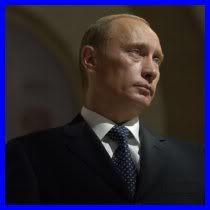
1.VLADIMIR PUTIN POSING FOR A PORTRAIT: This picture comes from the Time Magazine website, so it might be an official state portrait or something the magazine commissioned. Either way, even in an 'official capacity', this man still looks cool.Vladimir Putin Portrait for Time Magazine

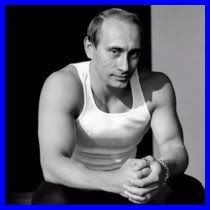
2.VLADIMIR PUTIN IN A BEEFCAKE PHOTO: And then there's this - clearly a posed photograph, but one in which he's wearing a wifebeater and showing off his manly muscles. Probably not a state portait, this one. Though you never know.Vladimir Putin Beefcake

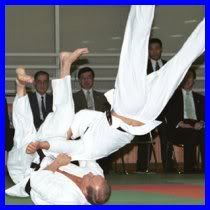
3.VLADIMIR PUTIN IN A JUDO COMPETITION: It is true that Putin does judo. And he's not kidding about it, either: he has a black belt and is clearly capable of throwing competitors around as if they were rag dolls. This competitor might be taking one for the glory of Mother Russia, except that the competition is in Japan, and I can't tell if he's Russian or not.Vladimir Putin in a Judo Competition in Japan

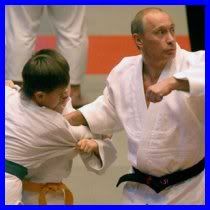
4.VLADIMIR PUTIN PUNCHES OUT A LITTLE KID: And when the competition gets too tough, Putin can always relax by kicking a little juvenile ass.Vladimir Putin Attacking a Small Boy

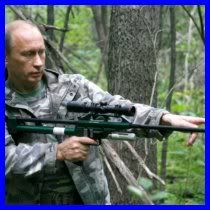
5.VLADIMIR PUTIN HOLDING A TRANQUILISER GUN: There are plenty of photos of Putin holding guns, many as manly as if they were stills from a Tarantino movie. This isn't actually a gun but a tranquiliser. He still looks like Rambo holding it, though.Vladimir Putin Taking Aim

6.VLADIMIR PUTIN HUNTING TIGERS: And this is why. The headline, that Putin saves a film crew by sedating a tiger, is Kim Jong-Il-esque in its chutzpah. But clearly he's been a-huntin'. Presumably he's about to dismember that animal with his bare hands, ripping out its still-beating heart.Vladimir Putin Hunting Tiger

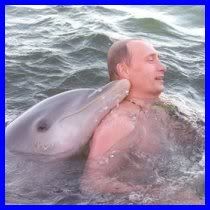
7.VLADIMIR PUTIN COMMUNICATING WITH DOLPHINS: Okay, this one isn't quite so heroic (there's one where he's swimming in a Siberian lake and looking like Moses parting the Red Sea), but it's still awesome to see Vlad chilling out in Cuba commisserating with dolphins.Vladimir Putin and a Dolphin

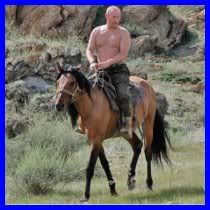
8.VLADIMIR PUTIN RIDING OFF INTO THE SUNSET: Another animal with which Putin has an affinity. Putin seems to ride horses a lot, sometimes fully clothed. This topless horse ride is not intended as a protest against taxes, I don't imagine. Perhaps he's chanelling the spirit of Genghis Khan.Vladimir Putin on Horseback

9.VLADIMIR PUTIN HIGH ON THE HOG: But a horse is so outré. What a dictator really needs is a bitchin' Harley on which to parade about, Russian flag fluttering and sunglasses in effect.Vladimir Putin on a Harley-Davidson

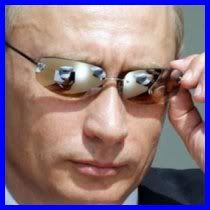
10.VLADIMIR PUTIN AS DAVID CARUSO IN CSI: MOSCOW: Those shades. Just look at them... Who else can pull off a set of Aviator sunglesses so adeptly? This is one cool guy. I can't look at this picture and not hear Roger Daltrey in my head screaming "Yeaaaah!"Vladimir Putin as David Caruso in CSI: Moscow